Module 4
Module 4
Mathematics
Module 4 focused on mathematics, differentiated instruction, and strategies for assisting students with dyscalculia. I explored valuable resources including Edutopia, The Teaching Channel, British Columbia Association of Math Teachers, and Dyscalculia.org as well as a plethora of resources shared and recommended by my classmates. At the end of this module, we examined a case study of a student who struggles with math and developed some strategies to support this student in the classroom.
 |
| Learning Objects (AdobeStock, n.d.) |
Case Study 7 -Annie
Student Profile:
Annie
Grade 3
Strengths and Interests:
- Likes to read
- Runs fast and enjoys gym
- Enjoys drawing, singing, and putting on plays
- Curious
- Enjoys playing with her friends
- Artistic
Stretches:
- Difficulty focusing on tasks
- Does not seem to hear instructions
- Fidgets
- Interrupts
- Distracts other students
- Challenges with math concepts
- Addition and subtraction facts to 10
- Subtraction with regrouping
- Noticing/reading symbols
- Lining up place value
- Difficulties with organization
Learning Style:
- Prefers to work in a quiet environment.
- Engaged when the topic or activity is something of interest
Suggested Strategies:
Math:
- Highlight symbols and key words in questions to draw her attention and reduce the amount of irrelevant information.
- Give instructions in short, simple steps
- Reduce stimuli by showing Annie how to cover up other questions on her page with a paper while focusing on one question. If this is unsuccessful, reduce the number of questions Annie is required to complete
- Provide all students with manipulatives, both physical and digital when appropriate.
- Teach using a variety of instructional strategies, for example class lessons using an interactive whiteboard, math stations, games, small group instruction, hands-on tasks, math read-alouds, and interactive lessons such as asking the students to solve a question on their white board and share it with the class, asking thumbs up thumbs down questions to assess for understanding, group problem solving tasks such as a math based escape room task (use strategic grouping).
- Practice skills taught on educational websites such as ABC.ya and Mathletics.
- Allow Annie to show her answers visually
- Strategic pairing/seating.
- Ensure Annie is seated with students she works well with and in close proximity to the teacher/whiteboard.
- Ensure Annie is seated away from distractions as much as possible
- Provide Annie (and any student who wants it), grid paper to correctly line up the numbers on the page. Annie may benefit from grid paper with raised tactile lines.
- Model think aloud strategies for math concepts and equations.
- Provide concrete manipulatives such as place value mats and base ten blocks to support concepts.
- Display anchor charts with foundational concepts.
- Read instructions together and check in with Annie to ensure comprehension
- When possible, provide Annie with a copy of the instructions, rather than have her copy from the board or write the instructions on a mini whiteboard for her to keep at her desk.
Focus:
- Provide all students with the option of wearing headphones or working in a quiet space.
- Offer Annie a standing desk or stretch bands on her chair
- Allow students to use fidgets to help them focus (Bandy, 2020).
- Set clear expectations around fidgets, including what are allowed as well as how and when they are to be used.
- Display visual aids of the schedule and provide students ample warning of what is coming up next. Remind students of what they will need for the next period (Bandy, 2020).
- Provide opportunities for movement such as
- regular brain breaks
- changes in instructional seating, for example having students sit at carpet, then at desks, then back to carpet, etc.
- Outside time
- If needed, ask Annie to run an errand such as delivering a note to the office (Bandy, 2020).
Organization:
- Use visual aids and keep a visual classroom schedule on the board. Offer Annie a First, Next, mini visual schedule for her desk
- Have consistent routines in place in the classroom
- Colour code duotangs by subject
- Schedule regular desk clean outs.
Making Mathematics Meaningful to Students
The teacher in the case above stated that Annie does not seem to understand or appreciate the usefulness of math in everyday life but she does seem to be engaged in activities of interest. It is important to make math meaningful to all students by using strategies that demonstrate the real-life applications of math. I think it would be a fair assumption that every person has a memory, whether it be as a teacher or as a student, of the question arising in math class: When will we ever use this?
While there are strategies and supports for students with dyscalculia, learning opportunities need to be meaningful for students in order to be engaging and motivating. During this module I found several strategies for increasing engagement in math by providing opportunities for students to see and participate in the real life applications of numeracy and problem solving.
Ideas and Strategies:
- Have students bring in materials from home that are connected to math so students can see the varying ways math is used in every day life. Students write a brief statement of how the materials connect to math and put them on display on the math wall (Minero, 2018).
 |
| (Image from Edutopia, 2018) |
- Real life role-playing
- Students act out real life scenarios such as restaurants or grocery shopping using play money and budgets (Minero, 2018).
- Adapt word problems to make them more meaningful.
- Substitute names and objects/place in word problems with student names and things that interest them (Moore, 2022).
- Create word problems based on community events or school events or concerns to make it more relevant to students (Moore, 2022).
- Integrate math across the curriculum. For example, to bring history to life, have students create measurements for a historical landmark.. In a grade 12 Social Studies class in New Jersey, teacher Ashley Swords had students estimate the space needed using the outdoor soccer field to determine how much space would be needed to bury the 11 million victims of the Holocaust. The teacher stated the activity was incredibly powerful for her students (Minero, 2018).
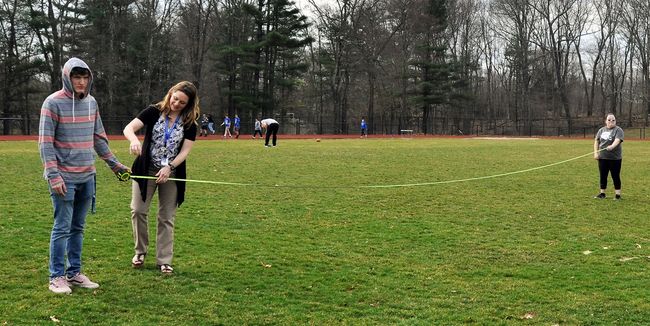 |
| (Image from Edutopia, 2018). |
- Use recipes and measurement to bake or create something
- Graph materials the students bring in. For example, when there is a school wide clean-up, graph the kinds of garbage found and discuss the impact on the environment based on those findings.
- Go on a grocery store field trip (Minero, 2018).
- Get to know students' interests by handing out surveys or graphing their interests (Holland, 2022).
Reflection:
Moving forward I feel I have a solid toolkit of strategies for supporting all students, including students with dyscalculia. In addition to strategies, I learned the value of peer group instructional supports and ways to design peer group lessons and foster collaboration to increase comprehension in math. I learned that dyscalculia often runs in families and that certain genes tend to be associated with both dyslexia and dyscalculia. Being aware of the the potential overlap between dyscalculia and dyslexia is significant when observing and evaluating students as well as ensuring students are receiving appropriate supports.
References:
Bandy, J (2020). Learn more by keeping it neat. ADDitude.com. Retrieved July 17, 2022 from https://www.additudemag.com/homework-studying-organization-adhd-child/
Hutchinson, N. (2004) Teaching exceptional children and adolescents case 7. https://onq.queensu.ca/content/enforced/685809-CONT905005S22/Readings/Teaching%20exceptional%20children%20%26%20adolescents%20case%207.pdf
Holland, N (2022). 3 Ways to integrate student experiences in elementary math. Edutopia.org. Retrieved July 18th, 2022 from https://www.edutopia.org/article/3-ways-integrate-student-experiences-elementary-math
Learning Objects (n.d). Learning objects [Image}. AdobeStock. https://stock.adobe.com/ca/Library/urn:aaid:sc:VA6C2:7499962f-ea31-4d96-99f6-18aad8e5ed40?asset_id=29249814
Minero, E (2018). 7 Real-world math strategies. Edutopia.org. Retrieved July 16th, 2022 from https://www.edutopia.org/article/7-real-world-math-strategies
Moore, K (2022). How to make math concepts feel relevant to students. Edutopia.org. Retrieved July 17, 2022 from https://www.edutopia.org/article/how-make-math-concepts-feel-relevant-students
Comments
Post a Comment